August 13, 2015

And so it begins

We arrived at our first station at around 7 o’clock in the morning on the 8th, and the approximate location can be seen in the first image as the white triangle at about 60°N and 180°E, near the Russian/U.S. economic exclusion zone (EEZ) boundary (in U.S. waters). On our transit to station 1, we had two rinse (or practice) stations, which are necessary for rinsing and testing the closing mechanisms of the Niskin bottles, and ensuring that our sampling procedures are efficient and our instruments are working properly.
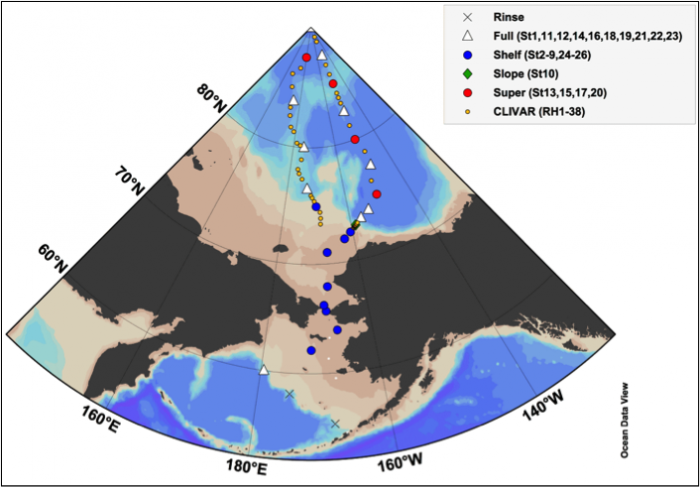
Station map planned for the 2015 U.S. GEOTRACES Arctic Expedition (Kadko, 2015).
At most stations during this cruise, we will be deploying rosettes equipped with either 12, 24 or 36 Niskin bottles to sample multiple depths throughout the water column (from bottom to top), illustrated by this animation and introduced in About the Cruise. Typically there are multiple casts at individual stations, either because there aren’t enough bottles in the rosette to resolve the full water column, or because multiple rosettes are necessary for our sampling requirements.

For the first cast of station 1, we deployed a special 24-bottle rosette, designed to prevent contamination from the ship (made of iron), so low concentrations of elements (i.e., trace elements) such as iron can be accurately sampled. Once we recovered the rosette, it was sampled by the GEOTRACES teams, who will later determine the concentrations of various trace elements in special laboratories at their home institutes.

Shortly after the recovery of the GEOTRACES rosette, a large-volume rosette, equipped with twelve 30 L bottles, was deployed using the A-frame on the starboard (right) side of the ship, which was deployed to a maximum depth of 740 m (or about 2440 feet). Casts usually take about 1 hour for every 1000 m, so after about 45 minutes the rosette was on deck and sampling began. Ryan and Fen sampled all Niskin bottles, which we have since analyzed for pH and total alkalinity (TA), and dissolved inorganic carbon (DIC) in the carbon van. While they sampled for those three parameters, I waited my turn to sample for dissolved organic carbon (DOC), which I have since preserved by placing samples in the freezer. Once the cruise is over and the Healy has returned to Seattle in November, coolers filled with frozen DOC samples will be shipped to Miami, where they will be analyzed at University of Miami’s Rosenstiel School of Marine and Atmospheric Science, where I am currently pursuing my PhD.

The large-volume rosette being deployed at station 1. Notice how the bottle caps (top and bottom) are held open by the spring-loaded lanyards. Once the maximum depth was reached, bottles were triggered to close at the desired depths, collecting our seawater samples. The instrument package under the bottles is the CTD sensor package.
I had hoped to write this post on the carbon van and some of our instruments, however, I thought it would be best to write about our first station. Ryan, Fen and I are just starting to get settled in the van, and now that the first station is behind us, we are getting a sense for the rhythm of our sampling and analysis procedures. Once we get that rhythm down, I will write a post about the work we are doing in the carbon van and the CO2 system in seawater.

How does our lab van look compared to in June when we were in Seattle? The instrument on the left analyzes samples for pH, while the instrument on the right analyzes for TA (second TA instrument in partial view on the left).
This is my last post for the week, so expect a new post either Monday or Tuesday next week. As I write this, all sampling at station 1 is complete and we are now steaming to station 2 to begin our shelf sampling stations.

—AA

August 11, 2015

A fond farewell

On the morning of the 9th, after having moved onto the Healy the night before, all of us cruise participants woke up in our cozy staterooms to make final preparations to leave port and begin the 2015 U.S. GEOTRACES Arctic Expedition at 1 pm. For the most part, final preparations consisted of organizing and securing our lab spaces, along with securing our bulky science gear that we had to store in the holds. The holds were secured by 1 and most everything in the labs was tied down, so we all went to the forward 02 deck (the deck that directly overlooks the bow) to watch the Coast Guard crew members pull in the ropes before the Healy was tugged away from the dock by two small tugboats. Embarking on long research cruises like this one is always exciting, and it was great to celebrate with so many faces that are just beginning to become familiar. I look forward to getting to know the cruise participants, and I know that this is just the beginning of many great memories to come.

Some of us who gathered on the forward 02 deck to celebrate the beginning of this great cruise.
 After our celebrations, we went to the conference room for the general orientation meeting, where members of the Coast Guard that we’ll be working with introduced themselves and briefed us on their roles on the vessel. Following the Coast Guard introductions, the cruise chief scientist, Dave Kadko, gave us an overview of the science plan for the cruise, noting the ice conditions and the schedule for the next few days.

Dave sharing the current ice conditions and discussing the science plan with the science party and Coast Guard. Captain Jason Hamilton can be seen sitting to the right of the white board.
Following the meeting, we had abandon ship and man overboard drills (typical for the first day of research cruises), which are always an interesting ways to get to know each other and to get to know the ship.

Trying on our survival suits in the helo hanger.
After having our science meetings and safety drills, all 145 of us (51 are scientists) were ready for a tasty dinner (with salad while it lasts!), and were prepared to spend two months at sea.

One of our last views of land as we left the waters of Unalaska and entered the Bering Sea.
My next post will be on the carbon van, which Ryan, Fen and I have organized beautifully!

—AA

August 8, 2015

A little closer to home

After spending a week in Alaska, Ryan and I met up with Fen in Anchorage on August 3rd, and the three of us (and other cruise participants) flew to Dutch Harbor, Unalaska, AK on the 4th. We flew in a Saab 340B aircraft, which is a fairly small plane, only having room for 30 passengers. To share what our flight was like, I placed a camera in a window, taking one photo every 30 seconds during the 3-hour flight.

Our flight to Dutch Harbor on 8/4/15, before beginning the 2015 U.S. GEOTRACES Arctic Expedition.

When we landed in Dutch, the first thing I noticed was that we were surrounded by beautiful rocky green hills and small mountains, which surprised me since the last thing I expected was to describe this place as beautiful. In addition to being surrounded by the hills, bald eagles are everywhere on the island, which are commonly spotted soaring in the sky or perched on top of buildings and light posts. Another treat on the island is wild salmonberries, which grow on a roadside hill that we pass on our walk to and from the Healy each day, and this morning I picked a handful to munch on as I walked towards the port.

A bald eagle on a light post.
Wild salmonberries make a tasty morning snack!
View of the port. The Healy can be seen on the right, and a sign for it can be seen on the hill to the left.
Aboard the Healy, everyone is busy setting up their lab spaces, which you’re already familiar with from my first post, Resting Easier. One new thing that recently happened is that berthing has been assigned, which excites me since the Healy is finally starting to feel a little more like home. We aren’t allowed to move into our rooms yet, but I managed to take a sneak peak of my stateroom to get an idea of what my living situation is going to be like over the next couple months. Since I have two roommates and are shifts are unlikely to overlap (I know Ryan and I will overlap by 4 hours), it’s unlikely that I will spend time in my room besides the time that I sleep because when I’m awake, my roommates will likely be sleeping.

The door to Ryan’s, Steve’s and my stateroom.
A desk and the beds in our stateroom. It looks like I'll be sleeping on the top bunk!
Our stateroom is much bigger than I expected. A second desk, a television (for monitoring deck/winch operations and station arrival), filing cabinets (for clothes?) and a sink.
I’d love to write more about Dutch Harbor and the Healy so far, but time (and the internet connection -- this) is limited on the island before the cruise, so I’m going to stop here. I hope you enjoy my writing and my photos! My next post will be from the Bering Sea! I hope you look forward to it as much as I do!

—AA

July 27, 2015

Pick it up and pack it away

I began packing my personal gear for the cruise in May when I squeezed my winter clothes and two months worth of toiletries into the spaces around science gear to fill coolers (pictured in Resting Easier post), which are currently stowed on the Healy. Following our work in Seattle aboard the Healy, I began organizing all of my possessions, deciding what to take to Alaska and what to leave behind in Miami. Since this cruise embarks at the beginning of a typical housing lease period (Aug. 1-July 31), I decided to skip signing a lease this year and move all of my belongings into a storage unit. One of the benefits to spending a couple months at sea, aside from the great scientific and travel opportunities, is that it is a great way to cut down on spending (on food, entertainment, and in ideal cases like this one, rent). I’ll get to food and entertainment in later posts, but for now I thought it’d be nice to share a little about the things that I’m leaving behind.

My beautiful storage unit and belongings.

In the above image, you probably just see someone else’s junk, which hurts (a little). What I see looking at this photo is a box filled with negatives and a broken Nikon FM2 camera that sparked my interest in photography. I see blueprints of houses that I helped build in San Antonio and a bookcase that I designed ten years ago, before moving to Colorado. I also see a summer’s supply of water from the back of a truck and a bunch of other great memories that led me to where I am now, in grad school pursuing my PhD in marine chemistry at the University of Miami.

Anyway, aside from the stale memories that I locked away, I’ve said a lot of goodbyes to people and places since returning from Seattle a month ago. One of the places that I will miss is the University of Miami’s Rosenstiel School campus, where I’ve gotten used to spending my weekdays working (in the building on the right, just behind the satellite dish), and on my weekends have frequented the beach behind the RV F.G. Walton Smith
.

Aerial view of the University of Miami’s Rosenstiel School of Marine and Atmospheric Science.

A group of people that I’ve said goodbye to is my lab — the Hansell Lab — who have previously accompanied me on long cruises during grad school, and it feels odd not having them with me on this one. I’m am lucky to have them support me with my blog efforts, and I know that they will lift my spirits when the trying days grow longer when the Healy goes north and the stations, sampling and analysis seem to never end. Hopefully I can capture aspects of those long days that shed light on Arctic Ocean and the science that the GEOTRACES and Repeat Hydrography teams will be conducting at sea.

The Hansell Lab in Antarctica on February 7, 2013. From left to right: Dennis, Sarah, Meredith and me. Not pictured: Cristina (postdoc), Lillian and Wenhao (lab technicians), and a group of hardworking undergrads.

As I write this, Ryan and I are flying in a 757 to Anchorage, and we’ll be landing in about an hour. I won’t be writing any posts until after we arrive in Dutch Harbor (on Aug. 4), but I’ll be sure to post (non-cruise related) photos to Instagram and Twitter, so be sure to follow me there to see what we’re up to!

—AA

July 10, 2015

Resting Easier

After packing all of our science equipment and personal gear to be shipped from Miami to Seattle (Figure 1), I knew that I wouldn’t be resting easy until after arriving in Seattle and loading our stuff onto the ship. But oddly, after spending the week of June 15-19 in Seattle moving everything on board and stocking up on ground coffee, chocolate, cashews and candied ginger for the long cruise, I didn’t feel any different. Over the past week my feelings changed, and now I realize why they hadn’t changed until writing this. But before I get to that, I want to share what our work in Seattle loading the USCGC Healy was like!

Figure 1. All of our equipment underneath the Science Library and Administrative Building (SLAB) at University of Miami’s Rosenstiel School of Marine and Atmospheric Science (RSMAS) on May 29. The five black boxes on the left contain instruments for analyzing the pH, total alkalinity and dissolved inorganic carbon (DIC) of seawater (a.k.a., the CO2 system in seawater). For the most part, the grey bins contain sample bottles for the CO2 system. The coolers on the right contain sample bottles and supplies for the analysis of dissolved organic carbon (DOC), which will be analyzed at RSMAS after they return to Miami in November.

On the afternoon of the 15th, Ryan picked me up from the bus station in Seattle’s International District (I spent the weekend in Portland visiting a friend), and then we grabbed some dinner and talked about our plans for the next few days before heading to the hotel and crashing after our long days/weekends of travel.

The next morning, we got to the Coast Guard base before 9 am. We assumed we wouldn’t be able to accomplish much since equipment was still being craned onto the ship, but we were happy to at least get a nice view of the city from the Healy (Figure 2). We were both thrilled to see how big the Healy is, since neither of us have sailed on it before, and we were both impressed. The Healy is a 420-foot-long icebreaker (or cutter), which is one the biggest non-nuclear polar icebreaker in the world. The Healy will be home to over 100 people (about 50 are scientists) during our upcoming 65-day cruise, and Ryan and I were happy with the layout of the ship, the location of our lab van, and most of all, we were excited to see new and familiar faces that we’ll get to know even better during the cruise.

Figure 2. View of Seattle from the USCGC Healy on June 16.
During the following two days, all of our equipment was craned next to our lab van (known as “the carbon van”) on the 02 deck, and Ryan and I began unpacking, arranging and securing the lab (tying everything down with rope, string or bungees). While we were in the carbon van those two days, I set up a camera and made a time-lapse video of the process (Video 1), which I hope you enjoy.

Video 1. Arranging and securing our lab in the carbon van on the USCGC Healy, June 17-18.

Anyway, I am fortunate to participate in the cruise and contribute to the groundbreaking science that will result from it, and this blog is my way of sharing some of that with you. I am excited about the cruise, but most of all, I am excited about sharing the experience with you. Finally, after months of putting this blog website together and not sharing it with anyone, I am so excited to share it with you. I am excited that I can finally rest easy knowing that this platform for learning about the Arctic, Earth science and life at sea is available to you.


—AA