August 8, 2018

Troubleshooting in the dark

Our flight to Longyearbyen was a little delayed, and all ~40 of us arrived there around 1:15 in the morning on July 30.

Once we got off the plane and retrieved our luggage, we boarded a tour bus that took us down the road to a small harbor where we waited for a small boat to take 5-6 of us at a time to Oden, since the harbor was too small for such a big, icebreaking ship.

I was in one of the last groups to catch the boat, so I walked around the area and took some photos.

View of the road back towards the airport, taken at 1:59 in the morning.

The following day (July 31) was spent getting reoriented on the ship, and getting instruments running and ready in the labs.

That evening a few of us took small-boat shuttles back to the harbor and walked into the town of Longyearbyen. On my walk, I stopped by a grocery store to buy souvenirs, candies and chocolate, as well as the neighboring brewery for my last beer on land.

View of Oden from the small boat on its way to the harbor, taken at 6:48 in the evening.

The following day (Aug 1) at 1:02 in the afternoon, a pilot boarded Oden to navigate us through the straits near Longyearbyen, and out to the Greenland Sea on the western side of Svalbard.

As the ship moved, my troubleshooting began, which involved testing a variety of things and solving a number of small problems that presented themselves. Since this is the first expedition that I’ve been on without having a supervisor on board, it was and is my responsibility to resolve any instrumental issues by troubleshooting.

However, I do have the capability to email my lab’s technician, Olivia, who is an expert with all of our instruments, or my supervisor, Elizabeth, who is the principal investigator of my Arctic project. Unfortunately, though, I quickly learned that for some reason my institute’s email server thinks my shipboard email is spam, so I wasn’t able to exchange emails with Olivia or Elizabeth until yesterday (Aug 7) evening! Over the past week, I truly was troubleshooting in the dark.

To take breaks from my troubleshooting, I’ve gone up to the bridge to get a nice view, as well as to focus on reading and writing. A few days ago I began reading The New Yorker’s “The white darkness: A solitary journey across Antarctica,” which seemed fitting for many of the white out days we’ve had so far, despite being about the other polar region.

At the start of our Arctic expedition, a quote from that reading stood out to me, which was actually taken from Shackleton’s The heart of the Antarctic, and it is as follows:

Men [and women] go out into the void spaces of the world for various reasons. Some are actuated simply by a love of adventure, some have the keen thirst for scientific knowledge, and others again are drawn away from the trodden paths by the ‘lure of little voices,’ the mysterious fascination of the unknown.

I’d say that quote probably resonates with everyone on this expedition, scientists and crew alike.

In addition to taking solitary breaks from work, I’ve also enjoyed the company of the people on board, who I’ve shared many delicious meals with so far, as well as coffees, teas and hot cocoas, and an occasional drink at the bar (once our work is done, of course!).

We’re making ripples into the void spaces of the world, taken on Aug 4 at 1:50 (GMT) in the afternoon.

My lab space is in good shape after a week of troubleshooting, taken Aug 7 at 1:53 (GMT) in the afternoon, while analyzing melted sections of a sea ice core for alkalinity and dissolved CO2.

Hopefully by the next time I write you, we will have reached the Pole. Whether we make it there or not, it’s nice and cool up here at 86.75°N :)
—AA

July 30, 2018

Poleward bound (a quick goodbye)

After mobilization in Helsingborg, Sweden, I enjoyed a two-week tour of Scandinavia as the Oden’s crew finalized the ship for its steam to Longyearbyen, Svalbard (Norway).


My last stop on the Scandinavian tour was Oslo, Norway, and I enjoyed an afternoon at the Fram Museum, learning about Norwegian polar legends such Roald Amundsen and Fridtjof Nansen, and the Framitselt.


As I walked around the museum, seeing relics of polar oceanography’s past, my travel companion said, “Our careers are built on all of this history,” which filled me with pride.

Oceanography—ranging from polar seas to the tropics—is a fascinating field of study.


A copper 'Nansen bottle' used to sample water, which is what today's Niskin bottle is based on.

As a scientist and communicator, I hope to tell stories of the upcoming expedition that will fill you with pride as well. 

On the deck of the Fram.
My flight to Longyearbyen will be boarding soon, so wish us luck on the expedition that is nearly underway, and please share the stories of our Arctic adventure.

—AA

July 18, 2018

All over again

Last week started out rough.

After Olivia and I were dropped off at the Richmond airport on Sunday, we learned that our instrument weighed 124 lbs. — 24 lbs. over the maximum allowable weight — so we were in trouble.

Me and our luggage and instruments at the Richmond airport.
The airline instructed us to take the instrument to cargo flights and that we could get there via airport shuttle, but the shuttle drivers did not know how to get to cargo and they instructed us to go back to the ticket counter, which was a good thing since cargo is actually closed on Sundays.

At that point we were getting concerned about not having enough time to get through security, so we asked to speak to a manager to sort out or weight issues.

Eventually, I realized that a part of the instrument that weighs ~20 lbs. could be removed from the case, which brought the weight of the case down to 100 lbs. and Olivia had the great idea of buying a small suitcase for the part — crisis averted!

After our two flights, we arrived in Copenhagen without issue, receiving all of our checked luggage and instruments.

Me and our luggage and instruments at the Copenhagen airport.
Getting to the train was also not an issue, since the station was only a minute walk from baggage claim.

Olivia and our luggage and instruments on board the train, crossing the straight into Sweden.
Once we boarded the train it was a 1-hour ride to Helsingborg, during which I enjoyed a nap through the Swedish countryside.

View of the Swedish countryside from the train.
Once we arrived at the train station in Helsingborg, Olivia and I took the elevator up to the bus terminal and we were greeted by familiar faces that we knew from previous expeditions we had been on, and we all waited for the shuttles to the Oden together.

Once we arrived at the Oden we had a quick orientation on board before instruments and supplies began being loaded onto the bow.

Being oriented in the galley on board the Oden.
Video clips from loading the Odenusing its crane.

Taking a break with Paty, the co-chief scientist of the expedition, and Jack and Petey, who I know from a 2013 expedition in the Ross Sea, Antarctica.
The following day, our two containers filled with supplies, instruments and spare parts arrived after being stuck in customs for a week.


The rest of the week we spent going over lists and unpacking supplies from various containers, as well as doing some safety training.

Paty pointing to chemicals for my group that have not arrived at the ship yet.
Palette of coolers shipped from the University of Washington, which I moved into the lab van that we’re using.
Evolution of our lab space. Photos taken 1) Tuesday morning, 2) Tuesday evening, 3) Thursday evening.
Video clips from our fire safety training for the expedition.

On Friday last week, all of our equipment was organized and secured on the Oden, and once that labor was done I made a video giving a quick tour of Oden.

A quick tour of the icebreaker Oden.


Over the next two weeks, I’ll be taking a holiday in Scandinavia before flying to Longyearbyen and beginning the expedition.

Please subscribe to this blog, and follow on Instagram and Twitter if you’d like updates while I’m at sea!
—AA

April 24, 2017

Photos for Science

I recently participated in the March for Science in Washington D.C., which I would love to write about, however, I don't have time as I only have a couple weeks to finish my dissertation! Instead, I'll share a link to photos that I took during the march: margolab.com/multimedia/ScienceMarch_photos.html


I think the signs, expressions on the faces of the marchers and rainy weather convey that science is important — rain or shine!
—AA

March 8, 2017

About the Arctic and Black Sea from Miami

So last week I was in Hawaii at the Aquatic Sciences Meeting where I participated in two Arctic workshops, attended two Arctic town hall meetings and numerous sessions on topics ranging from barium (that is, the “Ba” in Breaking Bad) in the Arctic Ocean to dissolved organic matter in the Sea of Japan. In this post, I’ll give you a summary of my productive week in Hawaii, now that I’m back home in Miami.

Photo taken by me, from here.
The early-career workshop
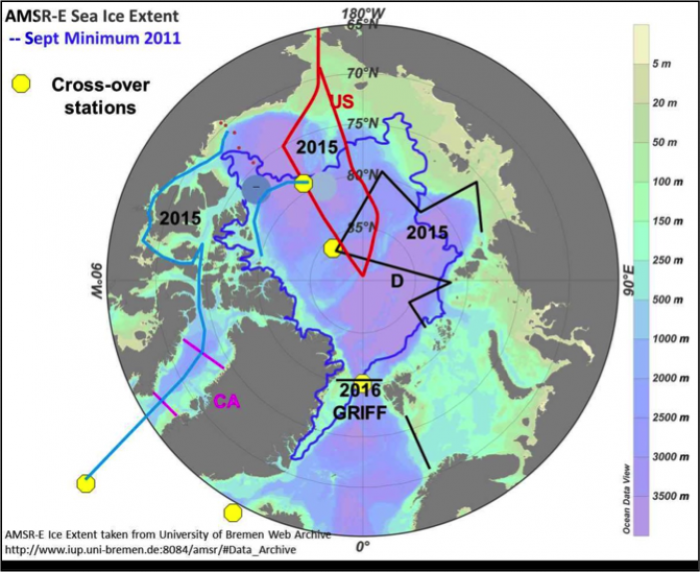
On Sunday, February 26 — the day after I landed in Hawaii — I attended an early-career Arctic GEOTRACES networking event/workshop, which was probably the highlight of my week. When I walked into the room where the workshop was held, I immediately felt at home since so many people there were from the U.S. program, who I spent months living with aboard the Healy in 2015. The workshop began with introductions from the Canadian, German and U.S. programs, and was followed by the workshop participants giving one-minute presentations on their work since 2015; I learned about all of the different projects, which was super cool! For my minute, I presented pH measurements from the marginal ice zone (MIZ), pointing out an eddy that I identified while at sea, which I mentioned in my previous post. I also presented the same material at the MIZ workshop later that week.

U.S. section is in red (US), Canadian sections are in pink/light blue (CA) and German section is in Black (D).  From ARCUS, here.
Once we finished our brief intros, we broke out into small groups to discuss various things, such as trace metal and carbon cycling, anthropogenic inputs and circulation. To my surprise, one of the groups focused their discussion on the eddy that I mentioned, which resolved some of the unexplained variations in the seawater chemistry. Some of the discussions from the workshop ended up being factored into the session talks later in the week, and I actually got a shout-out from Laura for identifying the eddy, since it explained some variations in the distributions of barium that she measured. There were multiple rounds of breakout group discussions, and I had a great time talking about the CO2 system and relaying discussion points back to Ryan. Once the discussions concluded, we made some future plans and ended the workshop by taking a group photo.


The sessions

So there were a number of sessions that I attended, including two that focused on (Ant)Arctic regions. I attended a session on Polar and high latitude research as well as the session on Trace elements and isotopes in the Arctic Ocean, which included talks from the international GEOTRACES Arctic program, co-organized by the chief and co-chief scientists of the U.S. GEOTRACES Arctic Expedition. I also attended sessions on The biogeochemistry of dissolved organic matter and Organic matter cycling across aquatic gradients, the latter of which I presented my 15-minute talk in on Wednesday.

The town halls

The first town hall that I went to was on the National Science Foundation (NSF) Arctic Sciences Section, during which I learned about some of the details of submitting proposals to obtain science funded, as well as logistical details, etc. It was pretty informative, and the knowledge that I gained will likely be useful as I move forward with my career. Currently, I am supported (tuition, stipend and some research expenses) by the NSF, and the U.S. GEOTRACES program is as well.

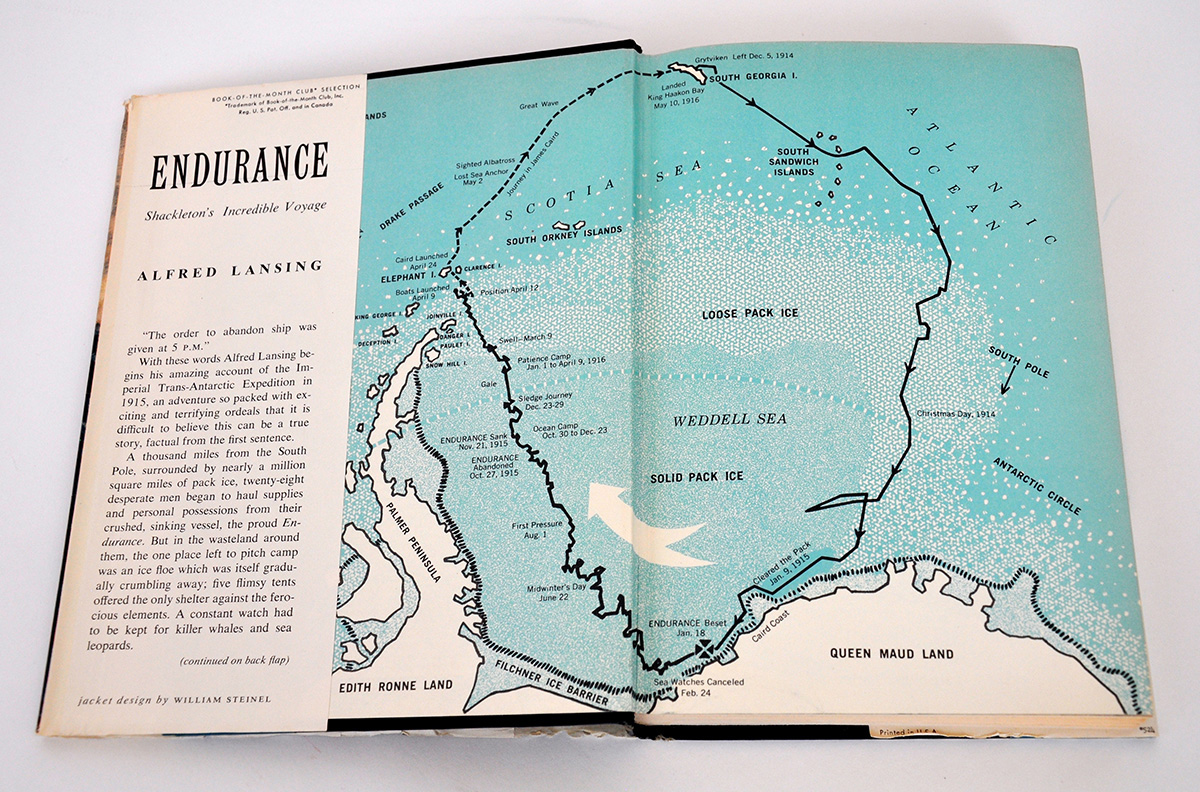
Out of curiosity, I also attended a town hall meeting on the MOSAiC International Arctic Drift Expedition, to learn about the field program that will be conducted from Oct 2019-Oct 2020, as well as any possible opportunities for me in the future. The idea of that program is for the Polarstern to drift with Arctic sea ice across the North Pole for a full year, with scientists taking measurements the entire time (in two-month shifts). The program reminds me of the Antarctic story of Shackleton and the Endurance, which is perhaps my favorite story of all time.

In other news

So I update Arctic News whenever I see a relevant/credible news article or video that aren’t tooo sciencey/hard to understand, but I don’t include the Ant to keep it simple. Anyway, here are a few Antarctic stories that have recently stood out to me:
February 16, 2017
March 1, 2017
March 8, 2017

Ask me questions! Also, send me feedback because I have no idea how many people actually read these posts! J
—AA